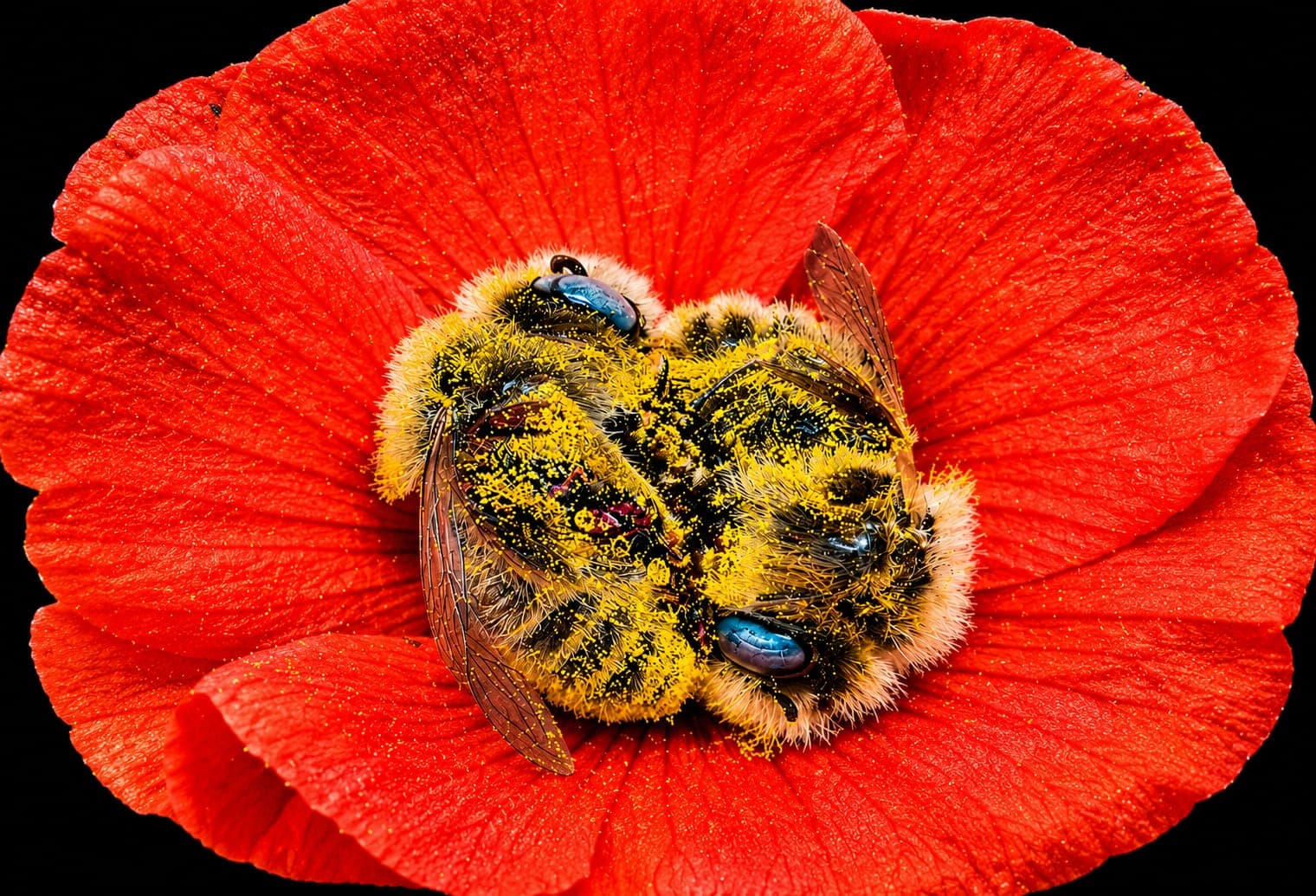
Photograph – ‘Two bees in a flower’
A detailed photograph of two bees, sitting within a vivid red flower, demonstrates a lovely and unique view. The bees are dusted with a golden yellow pollen and are tightly situated within the flower, against its soft petals.
Whilst it is often observed that bees travel from flower to flower to obtain food, this photo shows an alternative, more tranquil side to these insects.
Within the flower, the bees’ tight fitting position results in a highly peaceful visual. It serves as a good reminder that nature is rich with, and often overlooked, beauty.
Whilst it has not been independently verified where this photograph was taken and who the photographer was, it can still be used to examine further the interesting association that exists between bees and flowering plants.
Why Do Bees Visit flowers?
Generally, bees visit flowers to gain nectar and pollen. Both are key for the bee’s survival and also for sustaining a bee colony.
Nectar is a sweet liquid secreted by the flower. It is utilised by bees as a form of energy. Pollen is used for its high levels of protein, fat and various vitamins and minerals and is especially valuable for the nutrition of young bees.
Whilst travelling from flower to flower, pollen becomes attached to a bee’s fine hairs. Occasionally, this pollen will then be passed onto the flower’s sex organs so that it can successfully generate seed and subsequently, fruit for the plant.
Such natural pollination means that bees are frequently recognised as one of the most significant types of insect within many environments.
Why Are the bees dusted with yellow pollen?
Clearly, an outstanding feature of the photograph is the large quantity of yellow pollen that is adhering to the bees.
Bee’s bodies contain specialised hair which enables pollen to become attached. Moreover, numerous species have adapted tools which enable them to carry pollen back to their nests or colonies.
Honeybees, for instance, possess pollen combs on their back legs. This allows them to effectively carry pollen having gathered it from flowers.
Clearly, this photo emphasises the strong link between bees and flowers. Indeed, each journey that a bee makes between flowers can aid in the pollination of plants.
Why Might Two Bees sit together in a flower?
It seems that within the given photograph, two bees are situated together in a flower. Although it is not possible to ascertain definitively why this is occurring, there are several typical reasons for which bees may enter, or hover around, flowers.
To obtain food: It is possible that both bees are obtaining nectar and/or pollen from the flower.
To rest: Periods of stillness can occur between times that bees are travelling.
Physical features of the flower: Broad petals and/or concealed recesses can offer suitable resting spots for small insects.
Environmental factors: Temperature, wind and light can all impact on when and where bees are active.
However, it should not simply be assumed that the bees are sleeping, mating or engaging in specific social behaviour merely from viewing a photograph. Further investigation would be required to accurately establish what the bees were doing.
The mutual dependence of flowers and bees
The inter-relationship between bees and flowers is one of nature’s most significant associations.
Not only do flowers supply bees with food, but bees also assist in the sexual reproduction of flowering plants. This is therefore advantageous to both parties and positively affects the environment as a whole.
Whilst visiting a flower, a bee may become dusted with pollen from the male sex organs of that flower. Later, if the bee visits a further, appropriately matching flower, some of this pollen may then be passed to its female sex organs.
Successful pollination can result in seed formation and in many cases, subsequent fruit growth.
If pollinators were no longer available, the sexual reproduction of numerous flowering plant species could be compromised. This could in turn, impact upon an entire ecosystem.
Why Are bees so important for the environment?
Bees are highly significant for both the maintenance of biodiversity and for natural food provision. By pollinating, they facilitate the sexual reproduction of many wild flora and also aid the production of a range of crops that humans utilise.
Nevertheless, bees’ importance does not solely relate to food provision. As well as offering food, flowering plants also serve as homes for other animals including insects, birds and mammals. Thus, they are integral in the maintenance of a well balanced environment.
Key ways in which bees are beneficial are:
Aiding sexual reproduction: They pollinate and thus assist in the seed creation of many flowering plants.
Facilitating food production: Numerous fruit, vegetable and nut crops can all benefit from being pollinated by insects.
Maintaining biodiversity: Pollination is vital for the sexual reproduction of a broad range of wild plant life.
Assisting wildlife: Robust plant life can then offer food and housing for other species.
Sustaining ecosystems: Bees are involved in natural processes that are essential for the continued operation of environments.
This is especially pertinent as many plants rely on animals to effectively sexually reproduce.
Why is it important to protect bees?
Despite their significance, bees are vulnerable to a number of environmental issues.
Factors such as habitat destruction, exposure to pesticides, disease and parasites, climate change and the diminishing availability of flowering plants can all negatively impact bees.
Loss of habitats can limit both the locations where bees can construct their nests and also the number of flowers that they can access for food. In addition, bees can be adversely affected by the extensive application of particular types of pesticide, either whilst foraging or as a result of inhabiting polluted surroundings.
Both individuals, farmers, communities and governments can all take steps to safeguard bees.
Positive measures that may be employed include:
Creating suitable flora: Cultivate a diverse selection of flowering plants so that nectar and pollen is available for bees in varying seasons.
Minimising pesticide application: Avoid superfluous pesticide use, particularly if pollinators are attracted to flowering plants.
Preserving habitats: Continue to protect gardens, meadows, hedges and other areas, so that bees can access appropriate food and housing.
Promoting good gardening practice: Select plant species that are appropriate food sources for local pollinators.
Increasing knowledge: Inform people of the value of bees and the necessity for the protection of their habitats.
Even modest alterations can be implemented within gardens and outside areas to further enhance food and housing options for pollinators.
The beauty of nature’s detail
Wildlife photography can highlight previously unobserved aspects of nature. For example, a photograph can emphasise the detailed design of bees, the tactile quality of pollen and the sensitive construction of flowers’ petals.
To achieve a detailed photograph, it is necessary to exercise both patience and skill and also to ensure that optimal photographic conditions are present. Due to their swift movement, photographing small insects can be difficult.
Furthermore, images such as this can promote greater appreciation and examination of wildlife. Although a flower within a garden or a bee interacting with a plant may appear to be a commonplace occurrence, both are in fact integral to a far greater natural process.
In summary – a beautiful demonstration of nature’s importance
This photograph of two bees sitting together in a vibrant red flower beautifully illustrates nature’s beauty.
In addition to its aesthetic appeal, it emphasises the crucial bond between bees and flowers. Alongside aiding sexual reproduction of a huge array of plants, bees are valuable in food production and in sustaining sound environments.
Therefore, the protection of bees and their habitats is not only for the benefit of this insect group but also for the wider natural environment on which flora, fauna and indeed people all rely.
“Sometimes the smallest creatures play some of the biggest roles in keeping our natural world alive.”
Comments
Sign in or create a free account to join the conversation.
Loading comments…