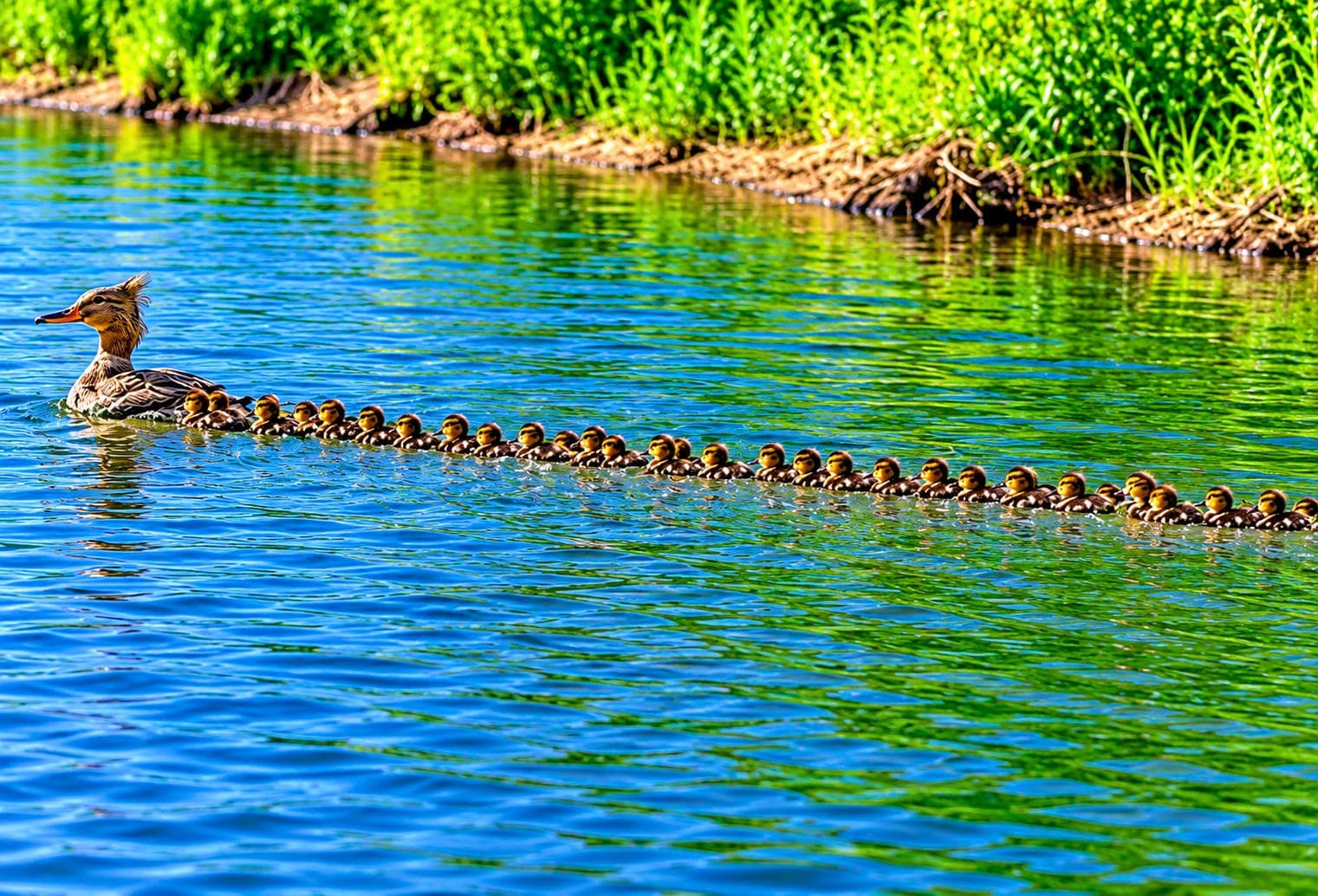
Lead mother duck and 76 ducklings
A photo which depicts a mother duck leading 76 ducklings across a Minnesota Lake has generated global interest. The image shows a mother duck leading a well-ordered line of plump ducklings.
Wildlife photographer Brent Cizek took the photo on Lake Bemidji in north Minnesota in 2018. Whilst initially seeming to show a highly unusual mother and family, it in fact highlighted an intriguing form of social behaviour amongst some birds.
The duck, which was later given the loving moniker ‘Mama Merganser,’, became highly popular both on-line and in global media reporting.
Whilst it did appear as though one mother was looking after a huge number of offspring, wildlife experts explained that this was in fact most probably a situation in which one duck was leading a collective of ducklings from a number of different mothers.
How was the unique duck family identified?
Whilst out on Lake Bemidji, wildlife photographer Brent Cizek came across a common merganser duck leading a large number of ducklings.
Initially he thought there were over 50 ducklings in total. As this was such an uncommon situation, he went back to the lake to take further photographs.
On his second visit he discovered that in total there were 76 ducklings being led by the mother duck.
Cizek was stunned by this, as he had never previously seen such a big number of ducklings being led by just one duck. Soon after taking the photographs, ‘Mama Merganser,’ became well known.
The photographs offered an engaging insight into a natural behaviour which may never otherwise have been witnessed by the general public.
What Is a common merganser?
The photographed bird is a female common merganser; a type of diving duck which can be found in various locations throughout North America, Europe and Asia.
Common mergansers are highly adapted to living in and around lakes and rivers. Being accomplished swimmers, they can submerge themselves and use their thin, saw-like beaks to fish and hunt for water-based food.
Typically, female common mergansers have reddish-brown heads and light coloured bodies. They therefore readily stand out compared to other types of ducks.
Generally, common mergansers look after far fewer ducklings than the astounding 76 which were led by ‘Mama Merganser,’. This is likely to be why so many wildlife lovers and experts were so fascinated by this particular situation.
Why Was One Mother Duck Looking After 76 ducklings?
The answer to this question centres upon a natural behaviour referred to as a ‘crèche’.
Within a crèche, young birds from separate nests are brought together and looked after by one or multiple mother figures. Rather than each mother solely looking after her own offspring, in some cases a more experienced mother can take on the role of leading a significantly bigger collective.
Experts thought that ‘Mama Merganser,’ was most likely to have been looking after ducklings from a number of separate broods, not necessarily all of which were her own offspring.
Furthermore, it is possible for female ducks to place their eggs within the nests of other females. Likewise, ducklings can transfer between different groups. Both of these behaviours can lead to the formation of large numbers of young birds.
In this instance, experts thought that ‘Mama Merganser,’ could have even been an elder and more experienced duck who was possibly related to many of the ducklings that she was leading.
Whilst it was not clear exactly how ‘Mama Merganser,’ came to be responsible for all of the ducklings, the crèche behaviour offered an effective explanation as to why such a large number was present.
What Is a duckling crèche?
A crèche is when a collection of young animals is brought together and often looked after by one or a number of adults.
Along with mergansers, this behaviour has been noted in a range of other bird species. It can enable young animals to gain from and be shielded by adults even if their actual parents are not present.
Whilst in a duckling crèche, the leading mother assists ducklings in searching for good feeding locations and appropriate resting spots. She can also aid them in avoiding predators and in understanding and travelling within an environment.
For ducklings, travelling in a group offers advantages over dispersing and travelling separately.
Although common mergansers often utilise crèches, the scale of this particular example – comprising 76 ducklings – was exceptionally high.
Why Did the Minnesota duck crèche become so big?
Experts proposed that atypical climatic and nesting circumstances may have played a part in facilitating the creation of such a large duckling crèche for ‘Mama Merganser,’.
As the weather remained frozen for a later-than-usual date in the spring, it is likely that a number of female ducks postponed their nesting times so that they all nested around the same time. Plus, the comparatively favourable climate enhanced the likelihood of eggs hatching successfully.
Consequently, the age-range of ducklings on the lake was largely similar, and so they were able to coalesce into one extensive group.
Whilst the typical size of a merganser crèche is usually considerably smaller (often around 40 ducklings), larger numbers have on occasion been seen. In fact, one Minnesota wildlife expert even mentioned that a couple of years previously he had seen over 100 ducklings on the same lake.
How Does the mother duck care for a large number of ducklings?
Ensuring the welfare of numerous ducklings is a considerable task. The mother duck is key in showing youngsters where to search for food and in enabling them to travel around the lake, as well as shielding them from threats.
Although common merganser ducklings can swim and begin to follow an adult shortly after hatching, they still require support and protection.
The leading mother can indicate to ducklings where good feeding locations are, for example, areas where small fish and other water-based food can be obtained.
Moreover, by remaining in a group, ducklings can more easily benefit from the expertise of an experienced leader and do not have to independently explore an environment.
Although the spectacle of 76 ducklings is highly impressive, this example effectively illustrated the advantages of group behaviour in nature.
What happens to ducklings as they mature?
Unfortunately, it was not anticipated that the ducklings would continue to stay together in such a large group for good.
As ducklings age, they will progressively grow flight feathers and become more self-sufficient. Hence, the mother will no longer need to continually lead them.
Experts went on to explain that ultimately, the crèche will disband as ducklings will then be able to forage and travel without assistance.
As autumn draws near, maturing mergansers can then merge with additional flocks of birds and begin to migrate in preparation for seasonal changes.
Depending on the time of year, common mergansers will migrate to different areas of North America. Some even head to more temperate climes in winter.
Why was the photo so globally popular?
Aside from illustrating an endearing natural scene, the picture of ‘Mama Merganser,’ and her ducklings beautifully demonstrated an intriguing natural behaviour.
Although it seemed as if one mother was leading an apparently interminable chain of offspring across the lake, the underlying science behind this behaviour was even more compelling.
It illustrated how birds can work together to care for young and also showcased how nature can produce intriguing social structures.
Furthermore, the episode provided much of the general public with information regarding common mergansers and the as-yet relatively unknown duckling crèche behaviour.
Conclusion – A superb illustration of natural teamwork
The tale of ‘Mama Merganser,’ and her 76 ducklings continues to be a striking example of the intriguing behaviour which can be encountered in nature.
Whilst on the surface it had seemed as though one mother was rearing an unrealistically large family, in reality it had in fact exemplified an innovative method of joint child-rearing by birds.
The female common merganser had effectively led a large set of ducklings across Lake Bemidji. This emphasised the crucial part which knowledgeable individuals can often play in safeguarding and directing the younger members of their species.
The photo served to highlight that nature is full of intriguing findings. Occasionally, the most astonishing wildlife-related events can occur in seemingly unassuming settings such as those around a standard lake.
“Nature's most remarkable families are not always defined by how many babies a mother gives birth to, but by how many young lives she helps protect.”


Comments
Sign in or create a free account to join the conversation.
Loading comments…